
The Human Learning Reinforcement Framework (HLRF)
By Jay Titus — Left Hand Security
AI should increase human capability without decreasing human understanding.
That is the principle behind the Human Learning Reinforcement Framework (HLRF), a proposed open framework we’re developing for keeping people’s knowledge and judgment current as AI does more of the work. The HLRF paper is coming soon. This is a preview.
Ask most AI vendors where people fit once AI takes on the work, and you’ll hear the same answer: the person just moves to the outer layer and reviews what the AI produces. That answer misses the whole problem. A reviewer who no longer does the work slowly stops understanding it, and often stops caring about it.
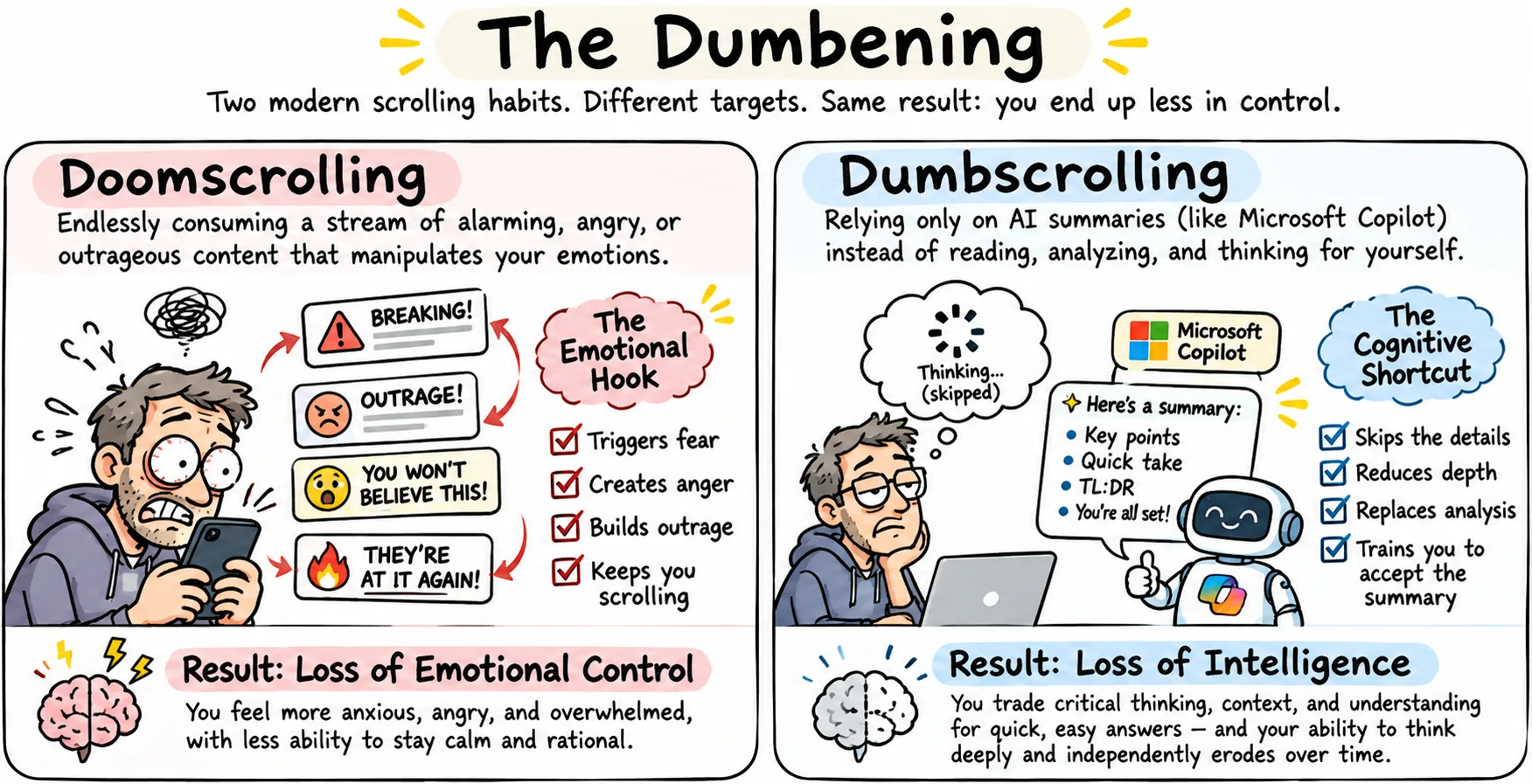
The Problem: Dumbscrolling
Social media and marketing learned to exploit human nature: content built to trigger fear and outrage keeps people scrolling. That became Doomscrolling, and it costs people control of their emotions.
AI is now doing something to how people think. When people build something themselves, the effort of researching, designing, debugging and fixing it is what commits the details to long-term memory. AI removes most of that effort. Instead of working a problem through, people ask the AI, scan what comes back and accept it. It’s much faster, but scanning rarely makes it into long-term memory, so understanding quietly fades while the work keeps getting approved.
We call this Dumbscrolling.
What HLRF Does
HLRF doesn’t try to stop AI doing the work. It treats human understanding as something to observe and measure, instead of assuming that reading AI output counts as learning. And it’s designed to get the most out of people: the judgment and creativity only they can bring, and the work that preserves their sense of purpose and value.
It Adapts to the Person and the Business
HLRF doesn’t decide where people belong in the work; the business does. Velocity Architecture shows where people, process or law set the limit, and which knowledge or attributes the business still values. HLRF adapts to that direction, and to each person within it: what they already know, what their role needs, and the work that preserves their sense of purpose and value.
If the direction is to take people out of the work entirely, HLRF has nothing to offer. It’s built for businesses that want AI to make their people more capable, not to replace them.
An Example: Nancy and Tom
Say your marketing team is Nancy and Tom. Between them they write three articles a week. They do it well, they know your business, and they love to write.
Most advice says to replace that with AI: train it on the hundreds of articles they’ve already written, let it do the writing, and have Nancy and Tom review and edit when something’s off.
Here’s what that misses. Nancy and Tom love to research and write. It’s creative, valuable work, and it’s a big part of why they like working for you and coming in every day. Turn them into full-time reviewers and you risk losing their judgment first, then the people.
This is where Velocity Architecture and HLRF work together. Velocity Architecture defines the balance: where AI adds speed, and where people set the limit. HLRF helps you maintain that balance and measure it. Maybe the savings outweigh keeping a marketing team, and you go that route. Or maybe you value their creativity and want to keep it. That doesn’t mean you can’t use AI. Instead of three articles, Nancy and Tom might write one themselves and edit the rest, keeping the quality up.
The fastest speed or the lowest cost isn’t always the best result. Velocity Architecture defines the limits. As a business, you decide what you want.
Six Principles
- Productivity Must Not Require Abandoning Understanding. AI can do the work, but people still need enough knowledge to exercise competent judgment over it when the function is moved to another layer.
- Reading Is Not Evidence of Understanding. Summaries and explanations are inputs to learning, not proof that it happened.
- Demonstrated Judgment Beats Passive Reading. Explaining, predicting, reviewing, debugging, threat modeling and correcting the AI’s output are all stronger evidence than reading about it.
- Reinforcement Should Match the Stakes. Don’t interrupt every interaction; step in when something consequential isn’t understood.
- People Must Know What AI Missed. Spotting wrong assumptions, missing requirements, security weaknesses and hallucinations is now a core part of the job, so HLRF measures it directly.
- People Must Stay Engaged. Take away the part of the work that drives people and you lose their judgment first, then the people. Velocity Architecture finds that limit too: People is the first question PROBE asks of every step.
Not a Surveillance Tool
HLRF is for the person, not for watching them. It exists to help people keep their engagement, their purpose and their skills while AI does more of the work, instead of letting AI quietly take them away.
Coming Soon
HLRF starts with AI-assisted software development, where coding agents make the problem easiest to see, and the same pattern reaches every field where AI does the work and people direct it. The paper will cover the models behind it and how it measures judgment. Talk to us if you’d like to hear when it’s out.
Don’t Dumbscroll your way through the Intelligence Revolution.